The best customer journeys don’t end at the purchase or sale. They loop back and start the next one.
When we were building Dockwa, we spent a lot of time with a simple model Google popularized: the five phases of travel.
Every trip moves through dreaming, planning, booking, experiencing, and reflecting. It’s a useful map. But the more we worked with it, the less it looked like a line and the more it looked like a flywheel.
That shift, from funnel to flywheel, changed how we thought about growth. And it applies well beyond travel.
- Dreaming. Something sparks the idea of a trip: a friend’s photos, a story, a picture of a harbor at sunset. The traveler isn’t shopping yet. They’re imagining.
- Planning. The dream gets practical. Where exactly, when, how much, and what are the options? This is research, comparison, and a lot of open browser tabs.
- Booking. The traveler commits. Price, availability, and trust all have to line up at the same moment.
- Experiencing. The trip itself. This is where the promise made during dreaming either holds up or doesn’t.
- Reflecting. The traveler comes home and tells the story: photos, posts, reviews, and recommendations to friends.
Read top to bottom, it looks like a funnel. reflecting is the last step, the nice ending after the real work is done. That reading misses the most valuable part.
From funnel to flywheel
In a flywheel, reflecting isn’t the end. It’s the fuel for the next turn. Each stage hands momentum to the next:
- Dreaming → planning. Inspiration becomes intent. The traveler has a “where” and starts asking “how.” The job is to catch that shift before the intent drifts to a search engine or a competitor.
- Planning → booking. Research becomes confidence. Reviews and stories from past travelers do the heavy lifting here, because peers are more believable than anything a business says about itself.
- Booking → experiencing. A transaction becomes a real trip. Any gap between what was promised and what’s delivered sets the tone for everything shared afterward.
- Experiencing → reflecting. The trip becomes a story. The best time to capture it is during the trip or right after, while the feeling is fresh. Wait a week and the photos stay on the camera roll.
- Reflecting → dreaming. This is the loop that matters. One traveler’s photos, reviews, and recommendations become the spark for someone else’s dream.
User-generated content is what closes the loop. At Dockwa, a boater’s review of a harbor or a photo of a mooring field at sunset was exactly the thing that got another boater to pick that destination next season. The same content then helped them plan and book with confidence.
That’s the flywheel effect: every completed trip produces fuel for future trips. As the base of content grows, inspiring the next traveler gets cheaper, not more expensive.
Want your growth loop to actually spin?
We've built marketing and product-led growth motions at companies like HubSpot and Dockwa. Noreaster Group can help you turn your customers' experience into the content and distribution that wins the next one.
Set up a call with usBeyond travel: the customer purchasing flywheel
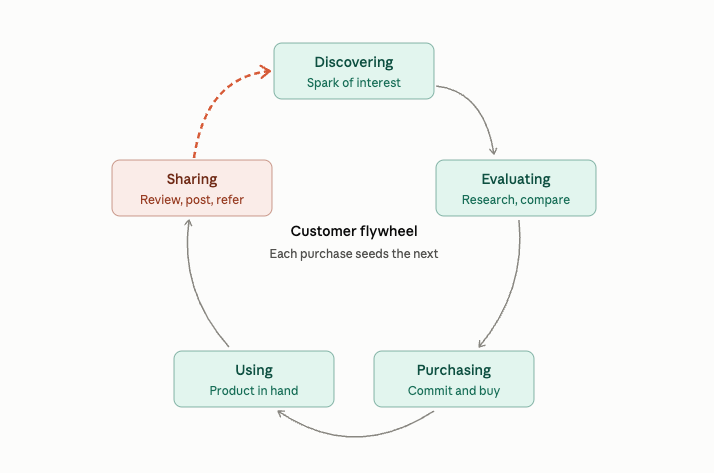
Swap “trip” for “purchase” and the same model describes almost any buyer’s journey, from a pair of boots to a piece of business software.
| Travel stage | Buyer stage | What the buyer is doing |
|---|---|---|
| Dreaming | Discovering | Noticing a want or a problem, often sparked by someone else’s post, recommendation, or review |
| Planning | Evaluating | Researching options, comparing, and looking for proof that people like them got what they wanted |
| Booking | Purchasing | Committing, once price, timing, and trust line up |
| Experiencing | Using | Unboxing, onboarding, and finding out whether the product delivers |
| reflecting | reflecting | Reviewing, posting, and recommending it to others |
The handoffs work the same way. Discovery turns into active evaluation. Peer reviews and real customer stories turn evaluation into a confident purchase. The first experience with the product decides whether the customer becomes a fan or a cautionary tale. And a happy customer’s review, post, or referral becomes the next buyer’s moment of discovery, and the trust signal that carries them through evaluation.
A funnel treats the sale as the finish line. A flywheel treats it as the start of the next sale.
What makes the flywheel actually spin
Drawing the circle is easy. Getting it to turn takes two things most companies only half do.
Deliver a customer experience worth talking about. Everything else in this flywheel rests on this. If the product, service, or destination doesn’t live up to its promise, the loop runs in reverse. The reviews turn lukewarm or negative, the photos never get posted, and the content that should be inspiring the next customer warns them off instead. No prompt or placement strategy can fix that. Before optimizing any other stage, make sure the experience itself is one people want to share. With that foundation in place, two more things determine how fast the wheel spins, and most companies only half do them.
Make reflecting effortless and well timed. Ask for the review, photo, or referral right after a moment of value: the end of a great stay, the first win with a new tool, the unboxing. Build the prompt into the product so it’s one tap, not a chore. The longer the gap between the experience and the ask, the less you get.
Put that content where new buyers are discovering and evaluating. This is the step that gets skipped. Plenty of companies collect reviews and then bury them on a page nobody visits. Customer content only closes the loop when it shows up in search results, on listing pages, in social feeds, and at the moment of decision.
Get both right and each customer makes the next one easier to win. Miss either and you’re back to a funnel, paying full price to fill the top every single time.
The takeaway
Google’s five stages of travel gave us a clear map of how people move from “wouldn’t it be nice” to “we’re going.” Turning that map into a loop is what makes it a growth model. Whether you’re selling slips at a marina or software to a small business, ask one question of every stage: how does this customer help bring us the next one?
Ready to put your growth flywheel to work?
At Noreaster Group, we bring together marketing and product-led growth experience from companies like HubSpot and Dockwa to help you close the loop between customers and growth.
Set up a call with us